
Python Programming · Career skills · Full course
Free Python course: from first program to tested code
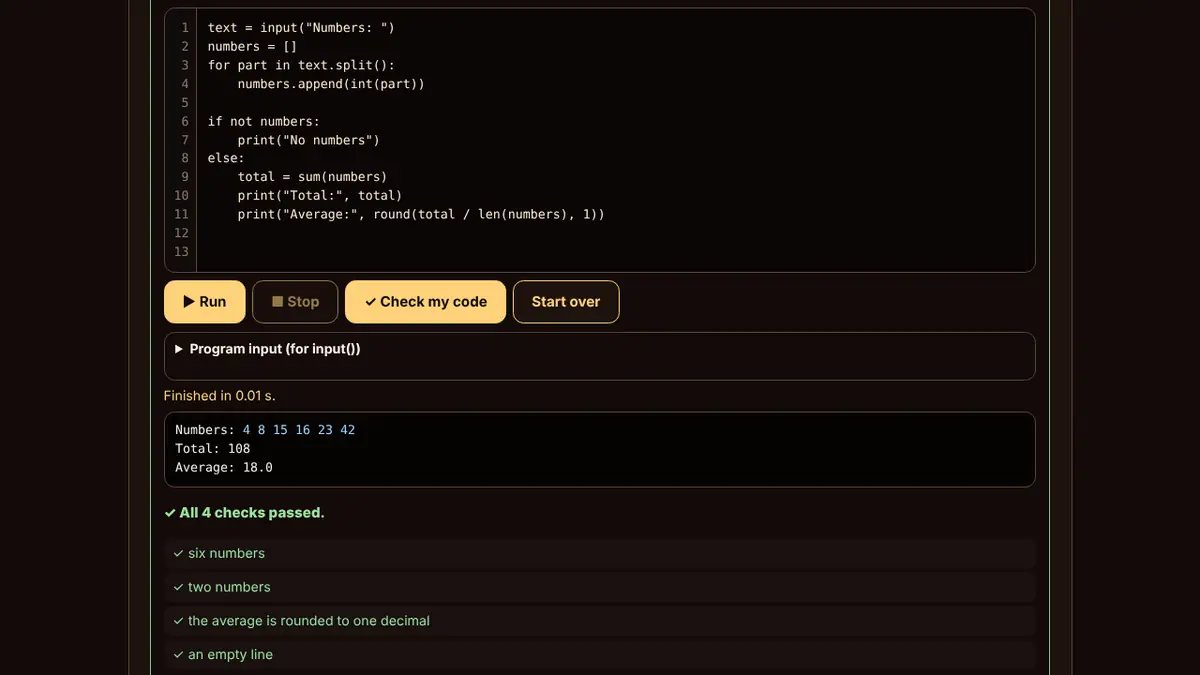
Python Programming is a free, full career course in Python for people aiming at junior developer jobs, with real Python running in your browser. It has 8 units and 32 lessons: values, variables and types, strings and f-strings, input and output, decisions and loops, lists, tuples, dictionaries and sets, comprehensions, functions and scope, classes, reading tracebacks, debugging, testing with assert and unittest, the standard library (math, random, datetime, collections, json and csv), turning messy CSV and JSON into summaries, searching, sorting and Big-O, a mini project, and Python at work with venv and pip.
Every lesson explains one idea in plain words, works a real example step by step, then asks two or three questions that make you use it. Wrong answers explain why and come back in Review until they stick. There are 152 practice and quiz questions in all, plus 14 hands-on labs: python playground, unit 1 coding exercises, unit 2 coding exercises, unit 3 coding exercises, unit 4 coding exercises, unit 5 coding exercises, unit 6 coding exercises, unit 7 coding exercises, predict-the-output tracer, traceback reader, debugging lab with planted bugs, CSV-to-summary data lab, mini project: stock report and final project workspace.
Pass every unit quiz with 80% or more and finish the final project, building a tested report tool that turns CSV or JSON data into a summary, to earn a printable certificate of completion. Progress is saved only in this browser on this device, with nothing to sign up for.
Every lesson is free: no ads, no lives and no paywall.
What you'll learn
- How Python runs a program, print and comments, values, types and variables, arithmetic and its traps, reading input, converting types and formatting output with f-strings.
- Indexing, slicing and string methods, comparisons and True or False logic, truthiness, if, elif and else, and while loops that repeat until a condition changes.
- for loops and range, totals and new lists, list methods, changing a list versus copying it, tuples, unpacking, zip and enumerate, and the patterns behind searching and filtering.
- Dictionaries for lookups by key, counting and grouping records, Counter and defaultdict, sets for uniqueness and fast membership, choosing a structure, and comprehensions.
- Functions with parameters and return values, defaults, keywords and docstrings, local and global scope, mutable arguments and the default-list trap, and classes with methods.
- Reading tracebacks from the bottom up, common exception types, try and except, raising your own errors, a step-by-step debugging method, and testing with assert and unittest.
- Modules, math, random and datetime, files and io.StringIO, CSV and JSON, a data pipeline from messy export to summary, and searching, sorting and Big-O.
- Plan a program, build and test a stock-report tool step by step, see Python at work in scripts, data and web back ends, use venv and pip, and plan your next credential.
All 8 units
- Unit 1Python foundationsYour first Python program · Values, variables and types · Numbers and arithmetic · Input, output and f-strings
- Unit 2Strings and decisionsWorking with strings · Booleans, comparisons and logic · if, elif and else · while loops
- Unit 3Loops and listsfor loops and range · Lists · Tuples, unpacking and zip · Loop patterns: search, filter and nest
- Unit 4Dictionaries, sets and comprehensionsDictionaries · Counting, grouping and nested data · Sets and choosing a structure · Comprehensions
- Unit 5Functions and classesDefining functions · Arguments, defaults and docstrings · Scope and mutability · Classes and objects
- Unit 6Errors, debugging and testingReading tracebacks · Handling and raising exceptions · A debugging method · Testing with assert and unittest
- Unit 7Standard library, data and algorithmsModules: math, random and datetime · Files, CSV and JSON with io.StringIO · From raw data to a summary · Searching, sorting and Big-O
- Unit 8Mini project and Python at workPlanning a program · Building and testing the mini project · Python at work · Tools, venv, pip and your next step
Questions
Is Python Programming really free?
Yes. Every lesson is free: no ads, no lives and no paywall. There is no account to make, and your progress is saved in your own browser.
Do I need to install Python?
No. Real Python 3 (CPython compiled to WebAssembly) runs inside the page, in a background worker, and downloads once the first time you press Run. The last unit shows how to install Python, use virtual environments and pip on your own computer, which is the natural next step.
How are the coding exercises checked?
Each exercise runs your code in that same Python and then runs hidden tests against it, telling you which checks passed and why the others failed. Every exercise has hints, and a worked solution with an explanation unlocks after two attempts.
Is the certificate an industry certification?
No. It shows you completed every lesson, passed every unit quiz and finished the project of a free Forge course. The course names a recognised next step, the Python Institute's PCEP exam, and the project you build is portfolio evidence in its own right.