
AI Skills Academy · Career skills · Full course
Free AI skills course: understand AI and use it well
AI Skills Academy is a free, full course on how artificial intelligence really works and how to use it well at school, at work and at home. It has 8 units and 32 lessons: what AI is and how chatbots predict text, writing strong prompts, catching made-up answers and bias, learning and working honestly with AI, images, voice clones and deepfakes, privacy and safety, and building AI workflows that are tested like a professional would test them.
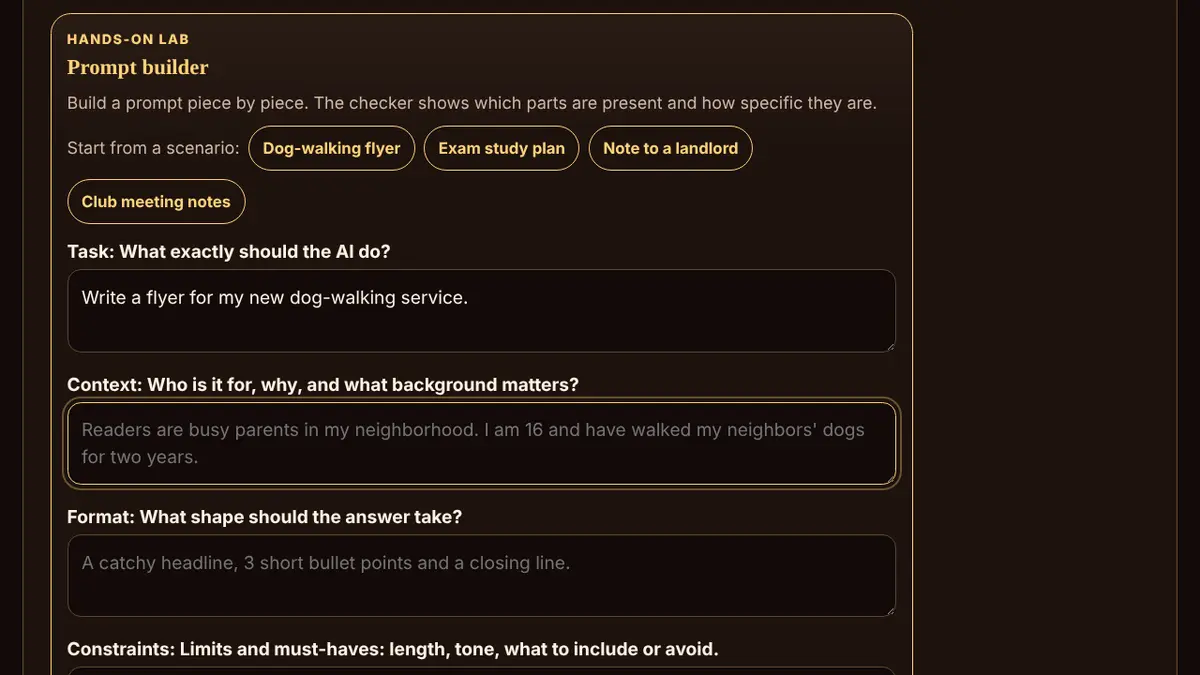
Every lesson explains one idea in plain words, works a real example step by step, then asks two or three questions that make you use it. Wrong answers explain why and come back in Review until they stick. There are 110 practice and quiz questions in all, plus five hands-on labs: next-word predictor, prompt builder, fact-check desk, real or fake? checker and privacy scrubber.
Pass every unit quiz with 80% or more and finish the final project, designing a tested, AI-assisted workflow for a real task, to earn a printable certificate of completion. Progress is saved only in this browser on this device, with nothing to sign up for.
Every lesson is free: no ads, no lives and no paywall.
What you'll learn
- How AI learns from examples instead of rules, the kinds of AI you already use, and what it is good and bad at.
- Next-word prediction, tokens, training, randomness and context: what is really happening when a chatbot answers.
- The five parts of a strong prompt, examples, step-by-step requests and editing like a pro.
- Hallucinations, verifying claims, known weak spots and bias: the skills that separate careful AI users from careless ones.
- Learning with AI instead of skipping the learning, drafting and summarizing, brainstorming and using AI honestly.
- How AI makes images, how to check whether a picture, video or voice is real, and how to create responsibly.
- What never to share, how AI tools can be tricked, fairness in big decisions and healthy AI habits.
- Automating real tasks, structured output, tools and agents, and testing an AI workflow like a professional.
All 8 units
- Unit 1What AI really isAI is software that learns patterns · Kinds of AI you already use · What AI is good and bad at · You are the pilot
- Unit 2How chatbots workPredicting the next word · Training: from raw text to helpful assistant · Why answers change: randomness and temperature · Context: what the chatbot can see
- Unit 3Writing great promptsThe five parts of a strong prompt · Show, do not just tell: examples · Break big jobs into steps · Edit like a pro
- Unit 4Checking AI's workHallucinations: confident and wrong · How to verify a claim · Known weak spots · Bias in, bias out
- Unit 5AI for school and workAI as a tutor, not a shortcut · Drafting, summarizing and editing · Brainstorming and planning · Honesty, credit and responsibility
- Unit 6Images, voices and deepfakesHow AI makes images · Checking if a picture or video is real · Voice clones and the emergency scam · Consent, copyright and respect
- Unit 7Privacy, safety and fairnessWhat not to share · How AI tools can be tricked · Fairness and big decisions · Healthy AI habits
- Unit 8Building with AIAutomate a real task · Ask for structured output · Tools and agents · Test it like a pro
Questions
Is AI Skills Academy really free?
Yes. Every lesson is free: no ads, no lives and no paywall. There is no account to make, and your progress is saved in your own browser.
Do I need to know how to code?
No. The course explains how AI works in plain words and teaches you to use it well. The last unit shows how AI fits into automated workflows, still without code.
Does it use a real AI?
The labs run in your browser and need no account: a tiny next-word predictor, a prompt builder, a fact-check desk, a deepfake checker and a privacy scrubber. An optional Claude coach can answer questions about the lessons.
Is the certificate an industry certification?
No. It shows you completed every lesson, passed every unit quiz and finished the project of a free Forge course. Many learners add it to a portfolio alongside the project itself.