
Language Lab · Beginner (A1) · Kana, kanji and romaji
Free Japanese lessons
日本語
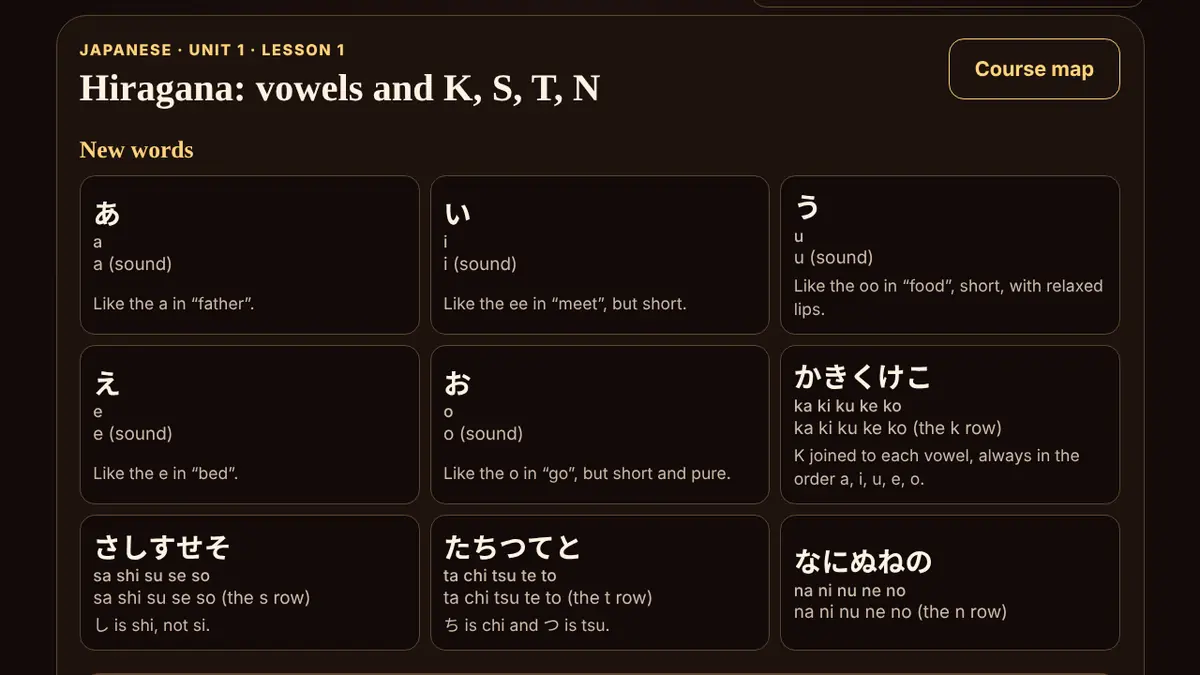
This free Japanese course is for complete beginners (level A1). It teaches Standard Japanese (polite です/ます style), plain forms introduced later. There are 10 units of 4 lessons, 40 lessons in all, running from Unit 1, “Hiragana and greetings”, to Unit 10, “Describing things”, with 362 words and phrases and 160 example sentences along the way.
Each lesson introduces about 9 words, explains one grammar point in plain English and then mixes seven kinds of practice: multiple choice, matching, listening, typing, building sentences from tiles, filling gaps and short conversations. Missed exercises come back at the end of the lesson and there is no limit on mistakes. Words you find hard return in review, and a checkpoint at the end of each unit (pass with 80%) opens the next one.
Japanese is written in hiragana, katakana and kanji. The course teaches the script from the first lesson, and every word and sentence comes with Hepburn romaji that you can show or hide. Progress is saved only in this browser on this device, with nothing to sign up for.
Every lesson is free: no ads, no lives and no paywall.
Beginner courses written by Forge from standard grammar references; each course names the variety it teaches.
What you'll learn
- Read the hiragana syllables, the small kana and long sounds, and greet people politely at any time of day.
- Introduce yourself, say what you do and where you are from, count to one hundred and give your age.
- Talk about your own family and other people’s, use の for “of”, point at people with この and あの, and count people.
- Read katakana for foreign words, name foods and drinks, use を with eating and drinking, order politely and say what you like and want.
- Name places in town, ask where things are, say what is where, go places by train or on foot, and follow directions.
- Tell the time, name the days of the week, talk about yesterday, today and tomorrow in the past and future, and give dates and birthdays.
- Describe your day from morning to night, say where you work or study, talk about free time and how often you do things, and meet the plain dictionary forms used with friends.
- Ask prices, count in hundreds and thousands, point at things with これ and この, describe colors and sizes, and count with the right counter.
- Buy tickets and ride trains, check in at a hotel, make plans with polite invitations, and ask for help or permission.
- Describe people, places and things with い- and な-adjectives, use them in the negative and the past, and compare two or more things.
Grammar in this course
All 10 units
- Unit 1Hiragana and greetingsHiragana: vowels and K, S, T, N · Hiragana: H to N, and voiced sounds · Small kana and long sounds · Greetings
- Unit 2Introductions, numbers and ageNice to meet you · Where are you from? · Numbers 1 to 10 · Numbers to 100 and age
- Unit 3Family and peopleMy family · Other people’s families · People around you · Counting people
- Unit 4Food and orderingKatakana for foreign words · Eating and drinking · Ordering · Likes and wants
- Unit 5Places and directionsAround town · What is where · Going places · Directions
- Unit 6Time, days and datesWhat time is it? · Days of the week · Yesterday, today and tomorrow · Dates and birthdays
- Unit 7Daily routineFrom morning to night · Work and study · Free time · Plain forms with friends
- Unit 8Shopping and pricesHow much is it? · This one, that one · Colors and sizes · Counting things
- Unit 9Travel and transportAt the station · At the hotel · Making plans · Asking for help
- Unit 10Describing thingsい-adjectives · な-adjectives · How was it? · Comparing
Questions
Is this Japanese course really free?
Yes. Every lesson is free: no ads, no lives and no paywall. There is no account to make, and your progress is saved in your own browser.
Which Japanese does the course teach?
Standard Japanese (polite です/ます style), plain forms introduced later.
How is the course organised?
10 units of 4 lessons (40 lessons). Every lesson has a word list, a grammar tip and about 15 short exercises, and every unit ends with a checkpoint. Pass it with 80% to open the next unit.
Do I need to know hiragana, katakana and kanji already?
No. The course teaches hiragana, katakana and kanji from the first lesson, and Hepburn romaji can be shown or hidden at any time.
Can I hear the pronunciation?
Yes, if your browser has a Japanese voice: tap the speaker button next to a word or sentence. Listening uses your browser's own voice, nothing is recorded and the course never uses your microphone.
Is this a certified course?
No. It is a beginner course written by Forge from standard grammar references, not a certified course or a qualification.