
Building AI-Powered Apps · Career skills · Full course
Free course: building AI-powered apps
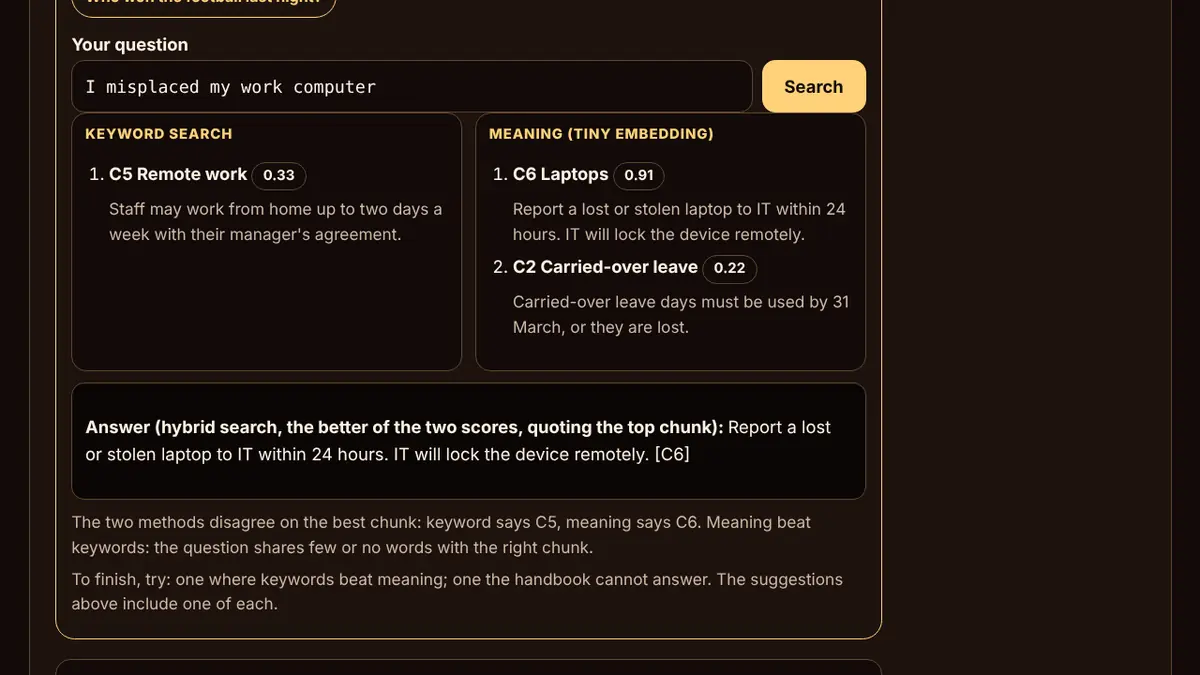
Building AI-Powered Apps is a free, full career course on how real applications use large language models. It has 8 units and 32 lessons: how an app calls a model API with the key kept on the server, tokens, cost, rate limits and streaming, system prompts and context, structured output and validation, tool calling with permissions and confirmation, retrieval-augmented generation with embeddings explained simply, guardrails against prompt injection, and evaluating, launching and running a feature with privacy built in.
Every lesson explains one idea in plain words, works a real example step by step, then asks two or three questions that make you use it. Wrong answers explain why and come back in Review until they stick. There are 144 practice and quiz questions in all, plus five hands-on labs: simulated model API and budget planner, validate-then-act pipeline, tool-calling simulator, retrieval demo and guardrail tester.
Pass every unit quiz with 80% or more and finish the final project, designing and documenting an AI-powered feature with costs, safety layers and launch criteria, to earn a printable certificate of completion. Progress is saved only in this browser on this device, with nothing to sign up for.
Every lesson is free: no ads, no lives and no paywall.
What you'll learn
- The three parts of an AI app, what a model API request and response contain, keeping API keys secret on the server, and why conversations must be re-sent every turn.
- Counting input and output tokens, working out what every request costs, handling rate limits and errors with backoff, and streaming answers so they feel fast.
- What a system prompt does in an app, writing and testing a production system prompt, adding context safely, and managing prompts like code.
- Why app features need structured output, defining schemas in code, the validate-then-act pipeline with business rules, and showing model output safely.
- How models ask your app to run tools, defining tools with schemas, running the tool loop safely in code, and protecting consequential actions.
- Why apps retrieve documents, embeddings and similarity explained simply, building a retrieval pipeline with chunks and citations, and how RAG fails.
- The threats an AI app faces, input guardrails, output guardrails, and defense in depth that limits what a fooled model can do.
- Evaluating an AI feature before launch, launching and operating it with monitoring and budgets, designing for privacy, and the checklist professionals use.
All 8 units
- Unit 1How an AI app worksThe three parts of an AI app · Anatomy of a model request · API keys and secrets · Conversations are stateless
- Unit 2Tokens, cost, limits and streamingCounting tokens · The cost of every request · Rate limits, errors and retries · Streaming and latency
- Unit 3System prompts and app behaviorWhat the system prompt does · Writing and testing a production system prompt · Adding context safely · Managing prompts like code
- Unit 4Structured output and validationWhy apps need structured output · Schemas in code · Validate, then act · Showing model output safely
- Unit 5Tool and function callingWhat tool calling is · Defining good tools · Running the loop in code · Safety with tools
- Unit 6Retrieval (RAG) and embeddingsWhy retrieval · Embeddings, explained simply · Building the pipeline · When RAG goes wrong
- Unit 7Guardrails and safetyWhat can go wrong · Input guardrails · Output guardrails · Defense in depth
- Unit 8Evaluating, shipping and privacyEvaluate before you ship · Launch and operate · Privacy by design · Putting it all together
Questions
Is Building AI-Powered Apps really free?
Yes. Every lesson is free: no ads, no lives and no paywall. There is no account to make, and your progress is saved in your own browser.
Do I need to be a programmer?
It helps to know some JavaScript or another language, because the lessons show short, provider-neutral code examples. Every idea is also explained in plain words, and Code Academy on this site teaches the basics.
Which AI provider does it use?
None. The lessons are provider-neutral, and the labs run entirely in your browser: a simulated model API with token counts, costs and rate limits, a validation pipeline, a tool-calling simulator, a retrieval demo and a guardrail tester. Prices in the course are invented for teaching.
Is the certificate an industry certification?
No. It shows you completed every lesson, passed every unit quiz and finished the project of a free Forge course. The design document you write for the project is portfolio evidence in its own right.