
Outbreak Lab · Public health basics
Free outbreak science lessons
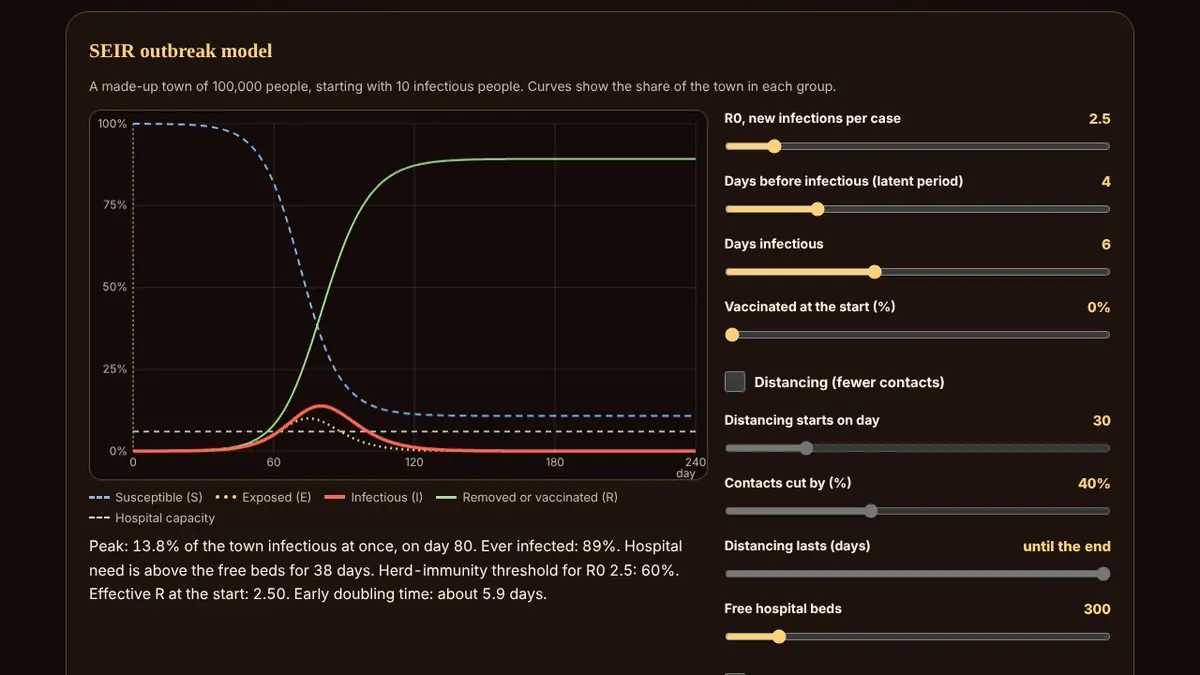
Outbreak Lab is a free course on how diseases spread and how public health stops them. It has 11 units and 36 short lessons, from germs and the chain of infection to R0, exponential growth, SIR and SEIR models, flattening the curve, vaccines and herd immunity, testing and tracing, layers of protection, reading outbreak charts and John Snow’s 1854 cholera map.
Each lesson has a key idea, the words it uses and quick questions with explanations. Five hands-on simulations let you change one thing at a time and watch what happens: SEIR model, Dot town, Fold the paper, Chart reader and Broad Street.
It is for learning, not medical advice. Every simulation uses a made-up town and a simple model, and none of them is a forecast of a real disease. Progress is saved only in this browser on this device, with nothing to sign up for.
Every lesson is free: no ads, no lives and no paywall.
What you'll learn
- What germs are, the routes they take, and the chain every spread follows.
- Incubation, the infectious period and the generation time that sets an outbreak's speed.
- How many people one case infects, what sets that number, and why 1 is the tipping point.
- Doubling, doubling time and why early numbers fool us.
- Compartment models, their equations in plain words, the peak and the limits of models.
- Hospital capacity, lowering and delaying the peak, and why timing matters.
- How vaccines protect, the herd-immunity threshold and how smallpox was eradicated.
- What test results mean, how contact tracing works, and isolation versus quarantine.
- Hand-washing, ventilation and masks, and the math of stacking layers.
- Log and linear scales, data that arrives late, and comparing places fairly.
- John Snow, the cholera map and the start of modern epidemiology.
All 11 units
- Unit 1Germs and how they travelWhat germs are · How germs travel · The chain of infection
- Unit 2The timeline of an infectionIncubation and latent periods · The infectious period · Generation time: the outbreak's clock
- Unit 3R0 and effective RWhat R0 means · What sets R0 · Effective R changes · Above and below 1
- Unit 4Exponential growthThe power of doubling · Doubling time and the rule of 70 · Why early numbers fool us
- Unit 5Modeling with SIR and SEIRBoxes called compartments · The equations in plain words · Why outbreaks peak and turn around · What models assume
- Unit 6Flattening the curveHospital capacity · Lowering and delaying the peak · Timing matters
- Unit 7Immunity and vaccinationHow vaccines protect · The herd-immunity threshold · Coverage, effectiveness and the math · Smallpox: a disease erased
- Unit 8Testing, tracing and isolationWhat a test result means · Contact tracing · Isolation and quarantine
- Unit 9Layers of protectionHand-washing · Ventilation and fresh air · Masks and the Swiss cheese model
- Unit 10Reading outbreak chartsLinear and log scales · Data arrives late · Comparing places fairly
- Unit 11Broad Street, 1854Cholera and the bad-air theory · The map and the pump · What happened next
Questions
Is Outbreak Lab really free?
Yes. Every lesson is free: no ads, no lives and no paywall. There is no account to make, and your progress is saved in your own browser.
Is this medical advice?
No. It is for learning. For health decisions, follow your doctor and your local public-health agency.
Are the simulations forecasts?
No. Every simulation uses a made-up town and a simple model, and none of them forecasts a real disease. Each one lists its assumptions.
Do I need to be good at maths?
No. The maths is explained in plain words, step by step, and the simulations let you see each idea before you calculate anything.
Where is my progress saved?
Only in this browser.